Pouring over peace
In 1995, following the horrors of the Rwandan Genocide, two distinct groups of women were left to rebuild their lives and support their families. On one side were women whose husbands had been killed during the conflict; on the other were women whose husbands had committed the atrocities. Though divided by the events of the past, both groups faced a shared challenge: survival. Without reconciliation, there could be no hope for communal development.
With the responsibility now on their shoulders, the need arose for collaboration and mutual support .Many of these women had coffee farms that their husbands had previously managed but they needed finance and infrastructure to produce good quality coffee. From this necessity, the Hingakawa Cooperative was born to unite these women, offering them a platform to collaborate, rebuild their lives, and create a sustainable future together.
Hingakawa played both an economic and social role in their lives. Economically, it regulated income, provided training on financial literacy, encouraged savings and pension programs, and supported improved farm management practices. Socially, Hingakawa created a safe space for these women to share their experiences, seek forgiveness, and forge peace within their community.
In 2004, Hingakawa became a sub-cooperative of Abakundakawa Cooperative, which broadened opportunities for its members by introducing initiatives such as income generation through specialty coffee production and processing, training in regenerative agriculture, and support for establishing new coffee plots to boost production.
Today, Hingakawa boasts 960 active women who produce around two containers of specialty coffee annually. Through their efforts in coffee trade, these women have rebuilt their livelihoods and fostered unity, proving that reconciliation and shared purpose can transform communities.
CULTIVARS
Arabica Bourbon types: French Mission, Jackson, Mbirizi, Pop 3303/21
ALTITUDE
1800 - 2,000 meters above sea level.
NOTABLE
This Side Up, with support from the SPVO Dutch grant, has launched a project centered on empowering women, particularly pregnant women and young mothers, by establishing a childcare facility managed by the cooperative. Through this project we will help women diversify their incomes by reviving a sewing project that had thrived before the COVID-19 pandemic. Additionally, the project will support the integration of shade trees on their plots, fostering an agroforestry system to enhance sustainability.
PROCESSING
ANAEROBIC HONEY : Only the finest cherries are selected and pulped without using water. The pulped coffee is then fermented in a covered tank for 48 to 72 hours, depending on weather and temperature conditions. Following fermentation, the cherries are pulped and dried immediately.
Cupping notes
2026 SAMPLES
-
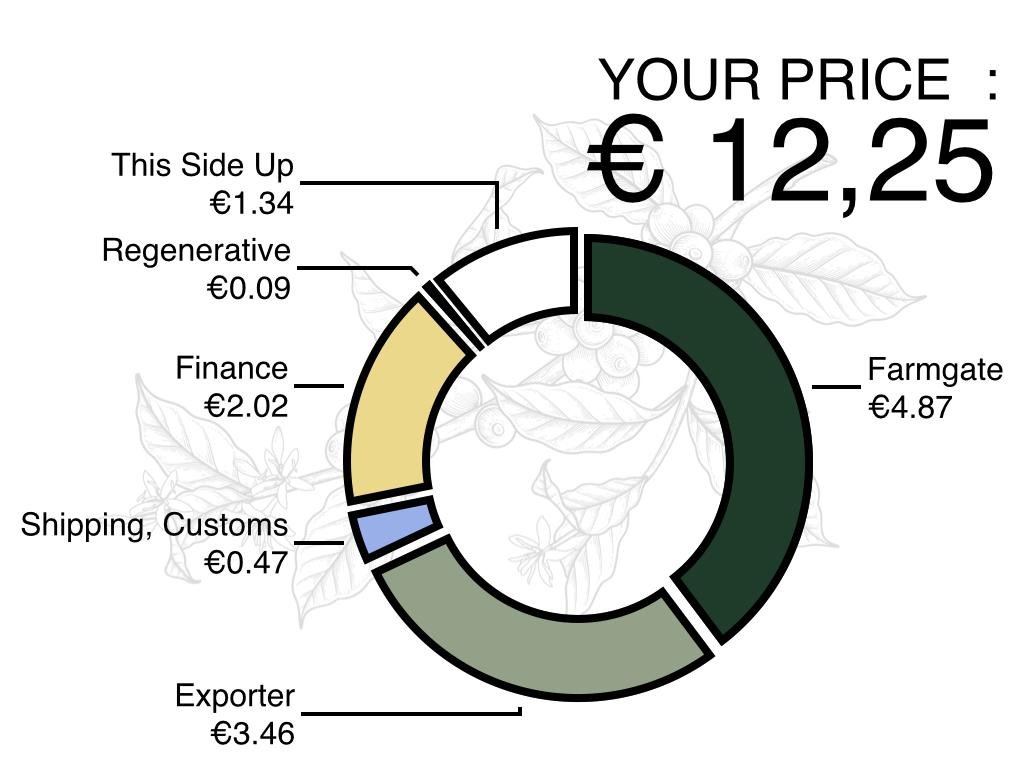
The price you pay for Hingakawa farmer group lot (anerobic honey ) p/kg. We agreed on this price directly with the farmers, disregarding the volatile US Coffee C price.
-
Farm gate constitutes almost 50% of the FOT paid to Abakundakawa. Abakundakawa pays a competitive premium on top of the cherry prices to incentivize the youth farmers that produce specialty grade coffee which is also included in this price.
-
The cooperative costs incurred by Abakundakawa include cherry, parchment processing, jute/grainpro bags, farmer training, management, certification and exporter fee. Abakundakawa also buys fertilizers and distributes them to farmers for free which is also included in their costs.
-
Misozi was the third party logistics service used this year to facilitate the shipping from Mombasa, Kenya to Rotterdam, Netherlands. Abakundakawa was responsible for organizing the shipment on truck from Rushashi to Kigali.
-
Average financing cost owed to (mostly social) lenders.
-
A standard TSU premium on all coffees designated exclusively to accelerate farmers’ own regenerative agriculture projects. Read more about the regenerative projects done by Rushashi here.
-
This Side Up compensation for spending time and resources importing this coffee. Our work includes year-round contact with producers, managing export, shipping, import, warehousing, grading, sampling, finding and keeping roasting partners for Hingakawa. € 1,34 is This Side Up’s Model 1 markup. For a full overview of our modular margin construction, see the Trade Models page.
PHOTO GALLERY
These pictures were taken by us during our recent visit to Abakundakawa.
You may use them freely to promote Hingakawa among your customers.