

Rushashi’s focus group
In Rutabo, villagers have owned the same piece of land, segmented into individual lots, since colonial times. If seen from a distance, this large plot could very well look like a single one. However, it was not until recently that farmers from this land started organising and working together as a group. After Abakundakawa began its efforts in the region, farmers changed from traditional to quality processing, came together, and began organising. Today, they all harvest on the same days, prune, and tend the land. Added to this, the group has a clear vision and perspective to make coffee sustainable in the long run: they save, invest, and have a credit system, they share this knowledge with farmers from other regions, and they motivate the youth to join coffee, “When you have a good harvest, invest” they say.
Added to this, it was precisely this group who, after noticing how young people were migrating, leaving the elderly behind and, with it, the future of coffee production, came up with the idea of creating a Youth group. This was the birth of Ishema, with whom we also collaborate, and is now a consolidated group of young coffee farmers.
CULTIVARS
Arabica Bourbon types: French Mission, Jackson, Mbirizi, Pop 3303/21
ALTITUDE
1,700 - 2,000 meters above sea level.
NOTABLE
In 2012 seven farmers from Rutabo came together and decided to start tending their large, divided land, as a group. Today, they are the strongest farmer group in the cooperative. During off-season, farmers tend another community land, where they harvest potato, maize and banana.
PROCESSING
Fully washed and triple fermented: all coffee is hand picked, depulped, dry fermented for 12 hours, double wet fermented (2 x 18 hours), washed with mountain water, shade dried, then sun dried on raised beds.
Naturals are shade dried, then sun dried and consistently turned to achieve the lowest possible amount of defects.
Cupping notes
2026 SAMPLES
-
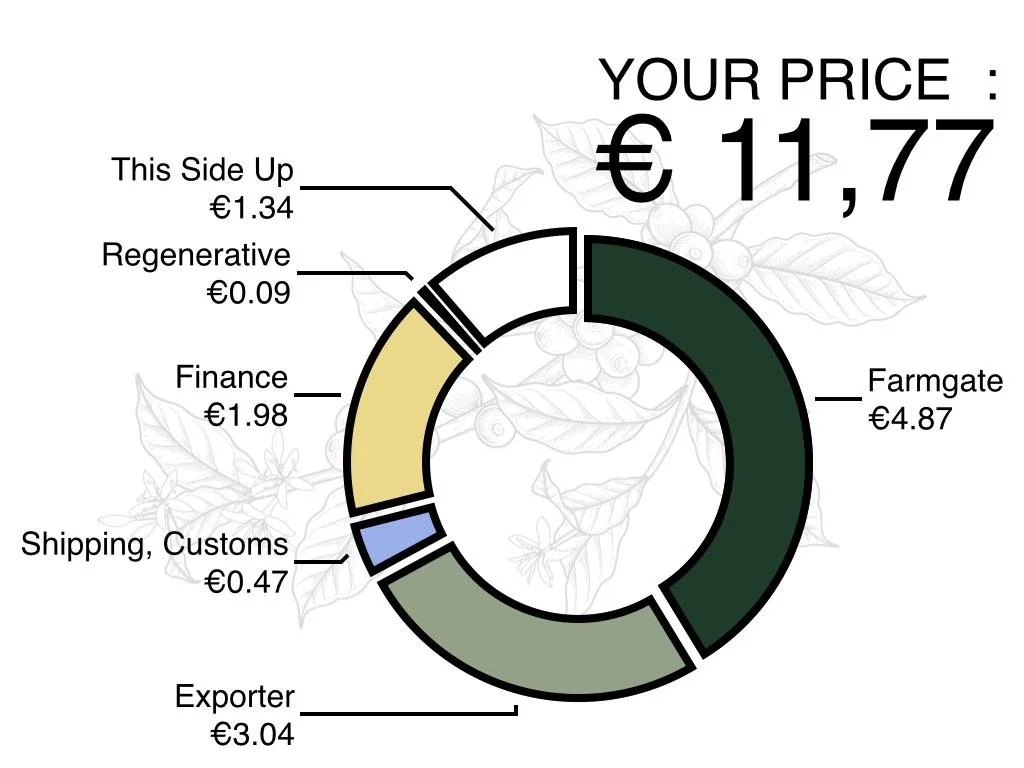
The price you pay for Rutabo honey and natural p/kg. We agreed on this price directly with the farmers, disregarding the volatile US Coffee C price.
-
Farm gate is the price paid to farmers for delivering ripe red cherries to the washing station at the respective collection point. It takes 7 kgs of cherries to make 1 kg of export grade specialty coffee. Farmers are paid well above the minimum prices set by the Rwandan Government which used around 0.40 USD per kg cherry.
-
The cooperative costs incurred by Abakundakawa include cherry, parchment processing, jute/grainpro bags, farmer training, management, certification and exporter fee. Abakundakawa also buys fertilizers and distributes them to farmers for free included in the costs.
-
Misozi was the third party service used this year to facilitate the shipping from Dar Es Salaam, Tanzania to Rotterdam, Netherlands. Abakundakawa was responsible for organizing the shipment from Rushashi to Kigali. This was a FOT contract.
-
Average financing cost owed to (mostly social) lenders. This ensures immediate payment to the farmers when the coffee leaves the farm or port.
-
A standard TSU premium on all coffees designated exclusively to accelerate farmers’ own regenerative agriculture projects. Read more about Rushashi’s regenerative efforts here where farmers are rehabilitating their farms. Read more here at Regenerative Premium
-
This Side Up compensation for spending time and resources importing this coffee. Our work includes year-round contact with producers, managing export, shipping, import, warehousing, grading, sampling, finding and keeping roasting partners for Rushashi. € 1,22 is This Side Up’s Model 1 markup. For a full overview of our modular margin construction, see the Trade Models page.