

keeping coffee alive
“In Rwanda, 80% of coffee growers are elderly. When they die, what will happen to their coffee?” Antoine Kagenza said. The options young people have in Rwanda are limited. A young man can help their parents with their lands, migrate to the city, or join the army. A young woman can either marry, migrate to the city and become a sewer, hairdresser or even turn to sex services. Unemployment is high, and the risk of joining gangs is also quite elevated. Added to this, about 80% of coffee growers in Rwanda are elderly. When farmers in Rutabo noticed this reality, they came together with a solution: to create a youth coffee group.
Since 2016 The Ishema Youth Coffee Group has steadily evolved into a strong organisation. It started with 63 members. That figure rose to 477 young farmers, of which 289 are young women. The elderly are also benefiting from this group since the heavy work is left for the young; older farmers choose to give a piece of their land to their young family relatives, increasing the production in their own plots. Added to this, young farmers are learning about finance, administration, and sustainable agricultural practices next to older farmers. They learn together and share knowledge.
CULTIVARS
Arabica Bourbon types: French Mission, Jackson, Mbirizi, Pop 3303/21
ALTITUDE
1,700 - 2,000 meters above sea level.
NOTABLE
Ishema Youth Coffee Group was born as a solution to the generational gap. Since 2016, the group has been steadily growing and attracting young women and man in Rushashi region.
PROCESSING
Fully washed and triple fermented: all coffee is hand picked, depulped, dry fermented for 12 hours, double wet fermented (2 x 18 hours), washed with mountain water, shade dried, then sun dried on raised beds.
Naturals are shade dried, then sun dried and consistently turned to achieve the lowest possible amount of defects.
Cupping notes
2026 HARVEST
-
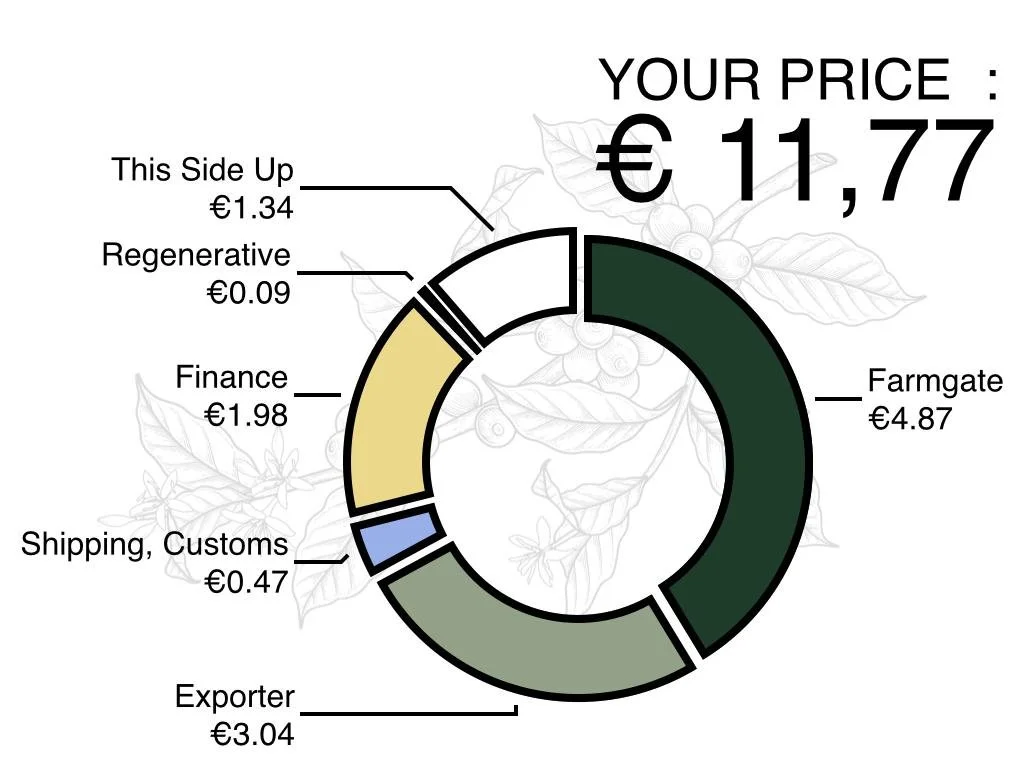
The price you pay for Ishema youth farmer group lot (washed ) p/kg. We agreed on this price directly with the farmers, disregarding the volatile US Coffee C price.
-
Farm gate is the price paid to farmers for delivering ripe red cherries to the washing station at the respective collection point. It takes 7 kgs of cherries to make 1 kg of export grade specialty coffee. Farmers are paid well above the minimum prices set by the Rwandan Government which used around 0.40 USD per kg cherry.
-
The cooperative costs incurred by Abakundakawa include cherry, parchment processing, jute/grainpro bags, farmer training, management, certification and exporter fee. Abakundakawa also buys fertilizers and distributes them to farmers for free which is also included in their costs.
-
Misozi was the third party logistics service used this year to facilitate the shipping from Dar Es Salaam, Tanzania to Rotterdam, Netherlands. Abakundakawa was responsible for organizing the shipment on truck from Rushashi to Kigali since this was a FOT contract.
-
Average financing cost owed to (mostly social) lenders. This ensures immediate payment to the farmers when the coffee leaves the farm or port.This year due to the involvement of Covoya, This Side Up borrowed less to cover for the Rwandan coffees.
-
A standard TSU premium on all coffees designated exclusively to accelerate farmers’ own regenerative agriculture projects. Read more about the regenerative projects done by Rushashi here. (Webpage Coming soon)
-
This Side Up compensation for spending time and resources importing this coffee. Our work includes year-round contact with producers, managing export, shipping, import, warehousing, grading, sampling, finding and keeping roasting partners for Rushashi. € 1,22 is This Side Up’s Model 1 markup. For a full overview of our modular margin construction, see the Trade Models page.