
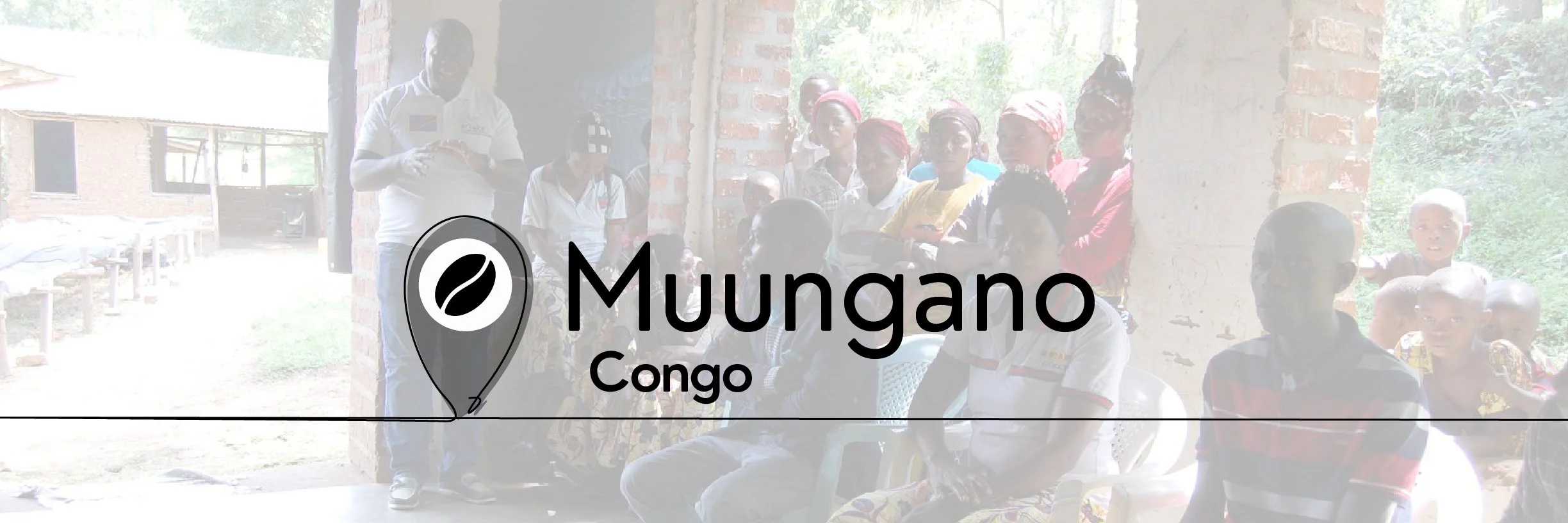
What I get from you, I share with them
Women are essential to the success of CPNCK in ways we could not imagine before hearing their accounts firsthand. When men cross Lake Kivu into Rwanda to sell their coffee, it also has other consequences: families separate; men often find a second or third wife in Rwanda, leaving their families unsafe and without resources. Women, with no decision power, are left in charge of 7 to 8 children; these children quickly become vulnerable to joining army groups…violence reproduces. For these reasons, CPNCK has emphasized attracting women since its start in 2014. Only through women, true social cohesion can happen.
Women also started attracting young people. Before these efforts, producers only worked with coffee in a traditional way and used to smuggle their coffee to Rwanda, putting their lives at risk. Women, on the other hand, had no say in money or coffee, and families were separated. Today, life is slowly but surely looking very different for women in Elodie, the leader of the Muungano group, grew up in Ngula, and personally knows all these women. As an agronomist, she is in charge of offering the technical assistance to these two groups and helping them to improve their coffee continuously. Added to this, the credit system allows the women to feel safe and recur to one another. Their housing has improved, and some children in these families seek professional development.
“Women instinctively know how to work together and manage detailed processing while caring about others”' shares James, CPNCK’s marketing manager. But when the female producers started gathering, receiving assistance and training to improve their coffee processing, and when they started getting more money, their husbands started gathering and asking questions. In traditional rural society, this was cause for clash that needed to be deeply addressed in the cooperative. Because of the strong standing of women in CPNCK’s management however, this resulted less in suppression of women inside the nuclear family and more in men also embracing more value added coffee activities - instead of smuggling.
In this group, female coffee producers share a motto "What I get from you, I share with them," over the years, this way of thinking has allowed the group to stay together and steadily grow their volume. We are proud to finally offer this lot to the European market.
CULTIVARS
Arabica JBM (a type of Typica) and Bourbon (Jackson)
ELEVATION
1,400 - 1,800 meters
NOTABLE
In Ngula, women's role in their families has changed thanks to our joint efforts with CPNCK. Today, they actively participate in economic and management decisions in their families and have managed to keep their families together. While spreading the benefits of coffee, women have attracted the youth and inspired men to change their traditional methods avoiding several severely damaging risks still latent today in this region. Besides growing coffee, farmers also grow cassava, walnuts, and banana; the increasing interest in sustainable agroecological practices is bringing this group of female farmers to the next level.
PROCESSING
Naturals : first shade dried to 14%, then sun dried and consistently turned towards 11%.
CUPPING NOTES

Browse through our Tastify Archives on Google Drive.

-
The price you pay for the Ngula women’s lot p/kg. We agreed on this price directly with CPNCK, disregarding the volatile US Coffee C price.
-
The price CPNCK pays farmers for their cherries as p/kg price of green (milled) coffee, including second payment. The farm gate cherry prices were assumed to be similar to last year (provided by CPNCK) which was the starting point for the calculations.
-
CPNCK’s wet-processing costs and export fee + Jambo Safari's dry milling fee + financing that was estimated to be 8.5% of the farmgate price.
Includes a 50 cent premium that goes to Muungano women’s group.
-
Total overland logistics costs from the mill on Idjwi to Bukavu, then to Mombasa, Kenya and shipping costs to Europe.
-
This Side Up compensation for spending time and resources importing this coffee. Our work includes year-round contact with producers, managing export, shipping, import, warehousing, grading, sampling, finding and keeping roasting partners for RAEK. € 1,55 is This Side Up’s Model 1 markup. For a full overview of our modular margin construction, see the Trade Models page.
-
Average financing cost owed to (mostly social) lenders. This ensures immediate payment to the farmers when the coffee leaves the farm or port. Interest rate on TSU loans and credit lines went up from 5.15 to 5.50 % this year.
-
A standard TSU premium on all coffees designated exclusively to accelerate farmers’ own regenerative agriculture projects.