
THE MAIN GROUP
Ngula’s main group , Maedelo, are the owners of the microstation and consist of women, men, and youth (30%). Besides coffee, they grow beans, bananas, walnuts, and cassava. Some members have goats, and a few have cows. This group has managed to work together, stay together, and increase their livelihood. But what does "increase livelihood" means in a neglected and overexploited country? In a country that still suffers the consequences of the genocide, violence and many other social issues, increased livelihood means family unity, a vision for the future and schooling for the children.
CULTIVARS
Arabica JBM (a type of Typica) and Bourbon (Jackson)
ELEVATION
1,500 - 1,700 meters
NOTABLE
CPNCK's mission is to work towards peace by offering an economical alternative to the most vulnerable population in the DRC; women, youth and men subject to smuggling. Their steady growth and strategic vision have allowed this vision to spread into other areas. So far, CPNCK has registered 132 army groups and 2388 members. The group invested in solar powered electricity systems and are actively putting into practice sustainable and agroforestry practices such as organic fertilisers, shaded coffee, and erosion prevention.
PROCESSING
Fully washed at microstations : wet fermented for 12 hours, washed with mountain water, shade dried and pre-sorted, then sun dried on raised beds.
Naturals : first shade dried to 14%, then sun dried and consistently turned towards 11%.
CUPPING NOTES

Browse through our Tastify Archives on Google Drive.
-
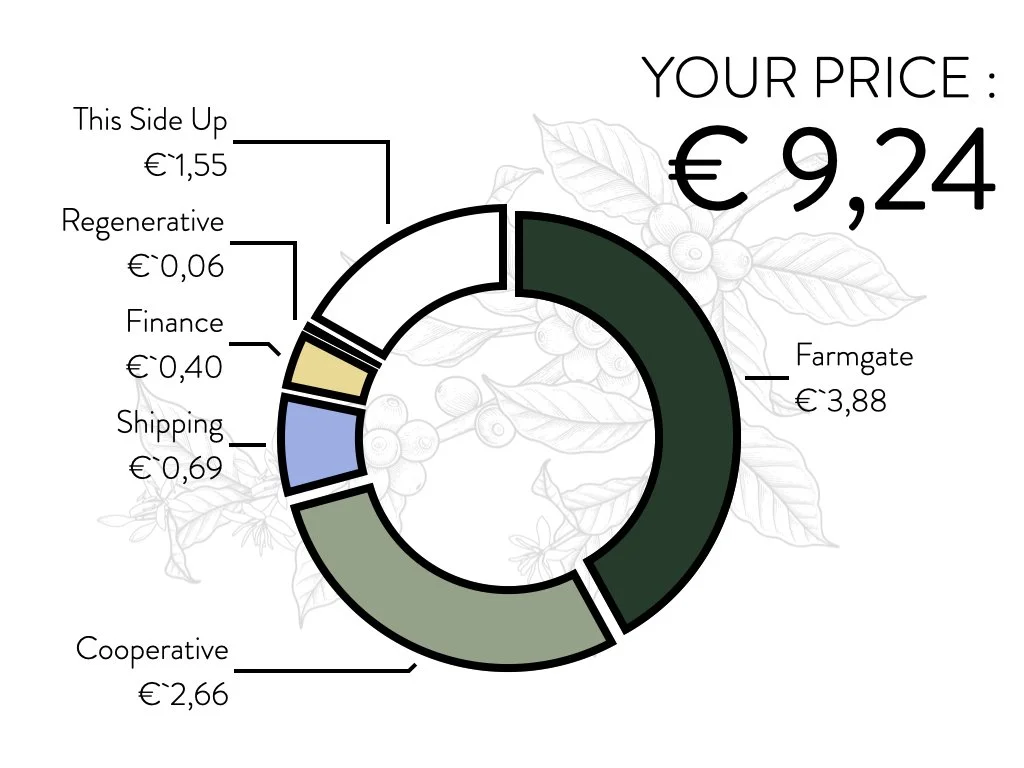
The price you pay for both the Ngula village lot washed and natural p/kg. We agreed on this price directly with CPNCK, disregarding the volatile US Coffee C price.
-
The price CPNCK pays farmers for their cherries as p/kg price of green (milled) coffee, including second payment. The farm gate cherry prices were assumed to be similar to last year (provided by CPNCK) which was the starting point for the calculations.
-
CPNCK’s wet-processing costs and export fee + Jambo Safari's dry milling fee + financing that was estimated to be 8.5% of the farmgate price.
-
Total overland logistics costs from the mill on Idjwi to Bukavu, then to Mombasa, Kenya and shipping costs to Europe.
-
This Side Up compensation for spending time and resources importing this coffee. Our work includes year-round contact with producers, managing export, shipping, import, warehousing, grading, sampling, finding and keeping roasting partners for RAEK. € 1,55 is This Side Up’s Model 1 markup. For a full overview of our modular margin construction, see the Trade Models page.
-
Average financing cost owed to (mostly social) lenders. This ensures immediate payment to the farmers when the coffee leaves the farm or port. Interest rate on TSU loans and credit lines went up from 5.15 to 5.50 % this year.
-
A standard TSU premium on all coffees designated exclusively to accelerate farmers’ own regenerative agriculture projects.